Beni Hasan
Beni Hasan is a group of 39 rock-cut tombs of Middle Kingdom governors on the Nile's east bank, about 20 km south of Minya, painted with scenes of daily life and wrestling. A foreign adult ticket costs about 200 EGP and the site opens 7 am – 5 pm.
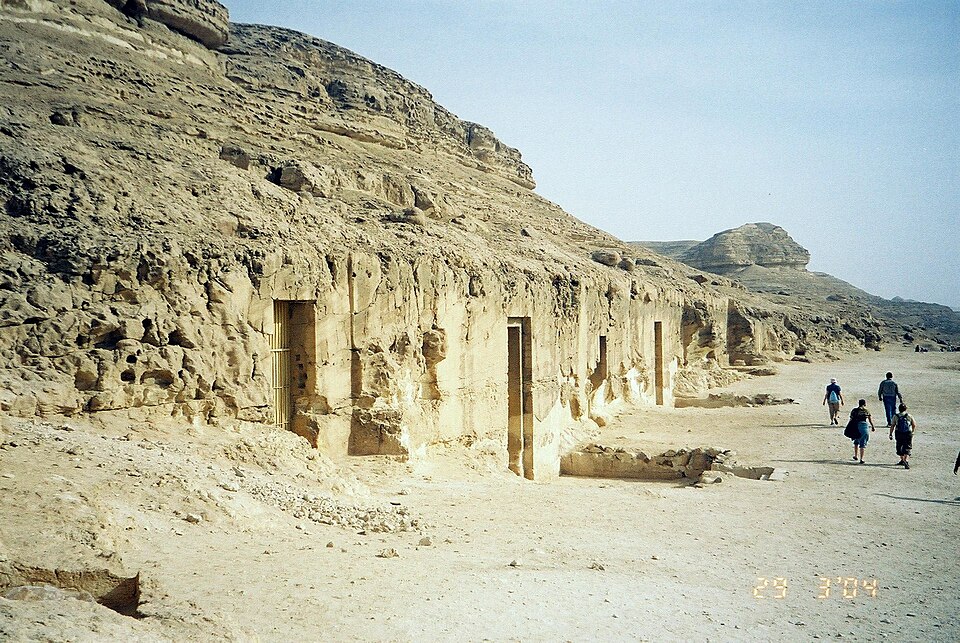
The 39 rock-cut tombs at Beni Hasan were made for the provincial governors (nomarchs) of the Oryx Nome, who ran this part of Middle Egypt in the Middle Kingdom. They sit high in a desert cliff with wide views across the Nile valley, reached today by a long stairway from the riverside road, and the climb pays off.
Four tombs are normally open, and they are very different from Luxor's painted royal tombs. Instead of religious texts, the walls are filled with everyday life in Middle Kingdom Egypt. The best known is Tomb 3, of Khnumhotep II. One register shows a group of Asiatic traders in boldly striped clothes, leading donkeys loaded with goods, one of the earliest images of people from the Levant in Egyptian art. Tomb 15, of Baqet III, shows more than 200 pairs of wrestlers in different holds, and martial arts historians study it as the oldest known fighting manual.
What to see
- Tomb of Khnumhotep II (BH3): Asiatic traders and hunting scenes
- Tomb of Baqet III (BH15): wrestling and battle scenes
- Tomb of Amenemhat (BH2), with a long autobiographical text
- Tomb of Kheti (BH17): farming and crafts
- The wide view of the Nile from the tomb terrace
Visiting
- Opening hours: 7 am – 5 pm
- Tickets: about 200 EGP for foreign adults
- Best plan: an overnight in Minya or a long day from Cairo
- Nearby: Tuna el-Gebel, Mallawi Museum, Akhetaten / Tell el-Amarna
Getting there
Coordinates: 27.9333, 30.8833
Frequently asked questions
How much is the Beni Hasan ticket?
About 200 EGP for a foreign adult. The tombs are open from 7 am to 5 pm.
How should I plan a visit to Beni Hasan?
Stay overnight in Minya, about 20 km north, or make it a long day from Cairo. Tuna el-Gebel, the Mallawi Museum and Tell el-Amarna are in the same area.
Which tombs at Beni Hasan are the best?
Four are usually open. The most famous is Khnumhotep II's tomb (BH3) with its caravan of Asiatic traders, while Baqet III's tomb (BH15) shows over 200 pairs of wrestlers.